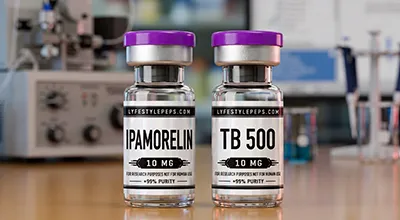
A research peptide is defined as much by its regulatory framework as by its chemistry. Lifestyle Peptides supplies synthetic peptide compounds under a Research Use Only designation, intended exclusively for laboratory and in vitro research settings. The chemical sequence of a research compound may resemble those studied elsewhere, but what distinguishes it here is the rigor applied to its manufacturing, labeling, and documentation.
Every compound in the catalog is built around this framework, giving researchers a consistent, well defined starting point for their own laboratory work across the entire catalog.
Molecular Structure and Sequence
A peptide is a short chain of amino acids connected by peptide bonds, formed when the carboxyl group of one amino acid reacts with the amino group of the next. That sequence, known as the peptide’s primary structure, determines its chemical behavior, including how it folds and how it may interact with other molecules in a research setting. Research peptides typically range from a few amino acids to roughly 50 residues, a size range that keeps them structurally simpler than proteins, which fold into far more complex three-dimensional shapes. This relative simplicity is part of what makes synthetic peptides so useful as research tools. A defined, short sequence can be synthesized with a known, exact composition, tested for identity using established analytical methods, and studied in isolation without the added structural variability that comes with larger protein molecules.
Lifestyle Peptides supplies compounds designed with this molecular precision in mind, ensuring that researchers work with fully characterized sequences rather than approximations, thereby supporting more reliable interpretation of results across a wide range of laboratory applications and experimental designs. This precision matters most when researchers are comparing compounds across multiple suppliers.
Confirmed Molecular Identity Testing
Knowing exactly what compound is being studied is a prerequisite for meaningful research data, which is why identity confirmation is treated as a core part of quality assurance at Lifestyle Peptides. Liquid chromatography mass spectrometry, or LC-MS, is used to confirm that a synthesized peptide matches its intended sequence before it is released for supply. This analytical step verifies molecular identity independently of the synthesis process, providing an objective check rather than relying solely on manufacturing records.
For researchers, this means the compound received is not simply assumed to be correct based on the order placed, but has been independently confirmed to match its stated sequence through recognized analytical methodology. This level of independent verification applies equally to every compound supplied here.
Verified High Purity Standards
Purity determines how much confidence a researcher can place in their own experimental results. Lifestyle Peptides holds every compound to a minimum purity standard of 98 percent by HPLC area percentage, with many batches verified at 99 percent or higher.
At this level, uncharacterized synthesis byproducts make up only a small fraction of the sample, reducing the uncertainty they could otherwise introduce into a research result. Purity is measured directly, batch by batch, rather than assumed from a general product specification. This standard remains consistent across every compound sold.
Applications in In-Vitro Research
Synthetic peptides serve as research tools across a wide range of in vitro applications, meaning experiments conducted in cell culture systems, biochemical assays, and other controlled environments outside a living organism. Researchers use compounds like those supplied by Lifestyle Peptides to characterize how a specific sequence interacts with a defined receptor, to investigate enzymatic function using activity assays, and to study signaling cascade behavior in cell culture models in response to specific molecular inputs. This in vitro focus allows researchers to isolate variables and study the behavior of a single peptide sequence without the added complexity of a full biological system. It also makes synthetic peptides valuable for early stage drug discovery and compound screening programs, where researchers characterize novel sequences before advancing to more complex study designs.
Because these compounds can be synthesized with precise, known sequences, they serve as reliable reference materials in pharmacological research, where knowing exactly what is being tested is essential for interpreting the resulting data. Lifestyle Peptides supplies compounds intended specifically for these controlled, laboratory based research applications, consistent with the Research Use Only framework under which every product is sold. This makes them valuable across many distinct areas of laboratory research.
Consistency Supports Reproducible Results
Reproducibility is one of the most fundamental requirements in laboratory science, and it depends directly on compound consistency. When a research peptide’s purity and identity are verified batch by batch, researchers can be more confident that variations in their results reflect the biological or chemical system under study rather than unexplained differences in the compound itself.
Lifestyle Peptides structures its synthesis, purification, and testing processes around this principle, supplying compounds intended to behave consistently from one batch to the next in a controlled laboratory setting, across the entire research process.