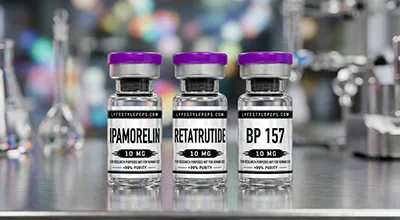
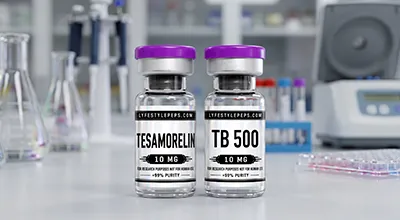
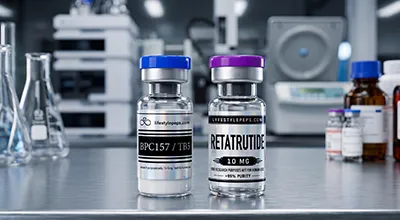
This section covers the foundational concepts every research professional should know before working with synthetic peptides. It begins with the distinction between a peptide and a protein, then moves into primary structure, the sequence-level property that defines a peptide’s chemical behavior. From there, it introduces the basics of synthetic manufacturing, the purity standards that determine research-grade quality, and the practices that define responsible sourcing.
Together, these five topics provide a working vocabulary for evaluating compounds, interpreting documentation, and making informed sourcing decisions carefully and confidently within a research setting.
Peptides Compared to Proteins
The distinction between a peptide and a protein is primarily one of size and structural complexity, rather than a difference in the type of chemical bond involved. Both are built from amino acids connected by peptide bonds, but the length of the chain and the way it folds set the two categories apart. Peptides are generally defined as chains ranging from two amino acids up to approximately fifty residues. Chains longer than that threshold are typically classified as proteins. Because peptides are shorter, they generally do not fold into the complex three-dimensional structures that characterize most proteins. This relative simplicity is one of the properties that makes synthetic peptides useful as research tools.
For instance, a peptide with a defined sequence of ten or twenty amino acids can be synthesized with known accuracy, verified by mass spectrometry, and used in a biochemical assay with a high degree of confidence in exactly what is being measured. A protein of several hundred amino acids introduces far more structural variables into the same experiment. This is why research peptides are widely used in early-stage laboratory work: their smaller size supports precise design, reliable manufacturing, and reproducible results.
Sequence Defines Peptide Behavior
Primary structure refers to the specific sequence in which amino acids are arranged along a peptide chain. This sequence is the single most important factor in determining how the molecule behaves, because it dictates how the chain folds, which regions become chemically reactive, and how the compound may interact with other molecules in a research setting. Even a single amino acid substitution within an otherwise identical sequence can change a peptide’s properties significantly, which is why sequence accuracy is treated as a core quality metric during synthesis. Because primary structure can be carefully designed and reliably verified with precision, researchers can study a defined molecular sequence under controlled conditions, confident that the compound being tested matches the intended design.
Manufacturing Fundamentals for Peptides
Synthetic peptides are manufactured using solid phase peptide synthesis, the standard technique across the research peptide industry since the 1960s. The chain is built one amino acid at a time on a solid resin support, with each addition following a protect couple deprotect cycle. Fmoc chemistry is the most common protecting group strategy typically used in this process. Once the full sequence is complete, the peptide is cleaved from the resin, purified to remove synthesis byproducts, and lyophilized into a stable powder suitable for research use, standard shipping, and long-term storage.
Setting the Purity Benchmark
Purity in a research peptide refers to the proportion of a sample that consists of the target compound relative to all other material present. The impurities found in a synthetic peptide are rarely random contaminants. They are typically predictable synthesis byproducts, such as truncated sequences and oxidation products, that co-purify with the target compound to varying degrees. When a research peptide contains a significant proportion of uncharacterized impurities, any experimental result produced using that compound carries additional uncertainty. A researcher cannot always determine with full certainty whether an observed effect in an assay is attributable to the target peptide itself or to an impurity present in the sample.
This uncertainty can clearly undermine both the reproducibility and the interpretability of experimental data, which is why purity is treated as a foundational quality metric rather than a secondary consideration. For this reason, research-grade peptides are generally held to a minimum purity standard of 98 percent by HPLC area percentage, meaning that at least 98 parts in every 100 of the UV-absorbing material in the sample represent the target compound. For applications where precise quantitation matters most, purity at or above 99 percent is generally preferred.
Choosing a Compliant Supplier
Responsible sourcing starts with evaluating a supplier’s documentation, testing independence, and RUO compliance across every channel. A compliant supplier provides batch-specific COAs before purchase, uses named third-party testing laboratories, and maintains RUO-consistent language across its website, product pages, and marketing materials, with no therapeutic, dosing, or human-use claims anywhere in that presentation.
Researchers should treat any supplier that makes health-related claims or that cannot produce verifiable testing documentation as a red flag. Sourcing responsibly protects the integrity of research data and keeps the purchase within its intended regulatory framework.