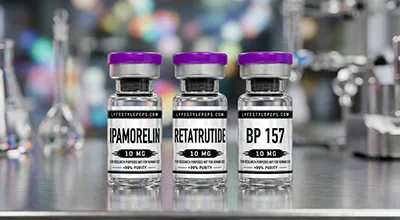
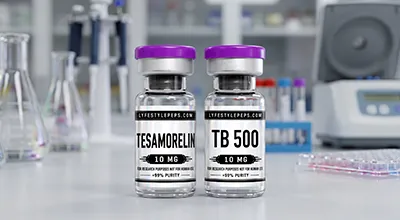
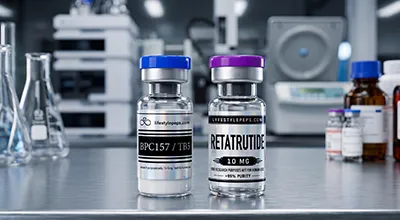
Research peptides sit at the intersection of chemistry, documentation, and regulatory compliance. This section walks through the fundamentals every research professional should understand before sourcing a compound: how peptides are built through solid phase peptide synthesis, how purification separates target sequences from synthesis byproducts, and how a Certificate of Analysis confirms identity and purity for a specific batch. It also outlines the Research Use Only framework that governs how these compounds are labeled, distributed, and purchased. Together, these five topics form a foundation for evaluating any research peptide supplier.
Defining the Peptide Molecule
A peptide is a short chain of amino acids joined together by peptide bonds. Each bond forms when the carboxyl group of one amino acid reacts with the amino group of the next, releasing a water molecule. This repeating linkage is what gives a peptide its backbone structure. The specific order in which amino acids appear along the backbone is called the primary structure, and it determines the molecule’s chemical behavior, including how it folds and how it may interact with other molecules in a controlled research setting. Peptides typically range from two amino acids up to roughly fifty residues in length.
Compounds within this range are generally distinguished from proteins, which are longer chains that fold into more complex three-dimensional structures. Because a peptide’s sequence can be synthesized with high precision, it can be manufactured to exact specifications and later confirmed by analytical methods such as mass spectrometry. This structural simplicity, paired with sequence-level accuracy, is one of the reasons synthetic peptides are widely used as defined research tools in laboratory settings, where reproducibility and precise molecular identity are essential to meaningful results.
Inside Solid Phase Synthesis
Solid phase peptide synthesis, or SPPS, is the standard method used to manufacture synthetic research peptides. The process begins by anchoring the first amino acid to a solid resin support, then building the chain one residue at a time, working from the C-terminus toward the N-terminus. Each coupling step activates the incoming amino acid so it can bond to the growing chain, followed by removal of a protecting group before the next addition.
Fmoc chemistry is the most widely used protecting-group strategy, applied under mild basic conditions between cycles. Once the full sequence is assembled, the peptide is cleaved from the resin, and any remaining protecting groups are removed, yielding the crude compound, ready to proceed to the purification stage.
Separating Target From Byproducts
The crude material produced by SPPS contains the target peptide along with synthesis byproducts, including truncated sequences and oxidation products. This mixture is not suitable for research use until it is purified. Reverse-phase high-performance liquid chromatography, or RP-HPLC, separates the target peptide from these related impurities based on differences in hydrophobicity.
The resulting purified fraction is then lyophilized, or freeze-dried, into a stable powder that can withstand standard shipping conditions and extended storage, giving researchers a reliable, well-characterized compound to work with across a range of downstream laboratory applications.
Understanding the COA Document
A Certificate of Analysis, or COA, is the batch-specific document that records the results of independent testing performed on a particular production lot of a research compound. Because RUO peptides are not subject to pre-market regulatory review, the COA functions as the primary quality assurance tool available to researchers evaluating a supplier. A complete COA should confirm the compound’s identity through LC-MS data, and should report purity as measured by high-performance liquid chromatography, along with the method used to generate that result. Beyond identity and purity, a thorough COA includes a batch or lot number matching the vial received, the date the analysis was performed, and the name of the independent laboratory that conducted the testing.
These elements allow a researcher to trace a specific compound to a verifiable test result, rather than relying on a general product description. When evaluating a supplier, researchers should confirm that COAs are available before purchase, not only afterward, and that the testing laboratory is clearly named rather than left generic. This documentation is what separates a compliant supplier from one that cannot substantiate its claims. Requesting this documentation before purchase helps researchers compare suppliers accurately and consistently.
Understanding the RUO Designation
Research Use Only, or RUO, is a regulatory designation that separates laboratory research compounds from diagnostic or therapeutic products. An RUO-labeled compound is intended strictly for laboratory research, not for human or animal use, and not for diagnostic, therapeutic, or preventative application.
This designation carries specific requirements for labeling, distribution, and documentation, and it defines how a supplier may present its products across every channel, including product pages and marketing materials. Purchasing under RUO also requires age verification, a stated research purpose, and formal acknowledgment of these use restrictions.